Rakhine-first Peace Plan Feasibility for Myanmar
Ernest Thiessen, Oct 272025
In light of our recent discussions about the feasibility and fundability of our peace plan for Myanmar, I’ve been reflecting on whether we should consider a strategic pivot in how we frame our Rotary Global Grant proposal.
Up to now, our modeling has addressed the entire country, while still using the term “Mini-Marshall Plan for Myanmar.” Focusing on Rakhine may make the term “mini” seem more logical..
We could still keep the national vision as our long-term goal, while defining our initial Rotary-supported phase as a Rakhine-focused pilot within that broader framework.
Here’s why this might make sense:
Rakhine as a microcosm of the national conflict
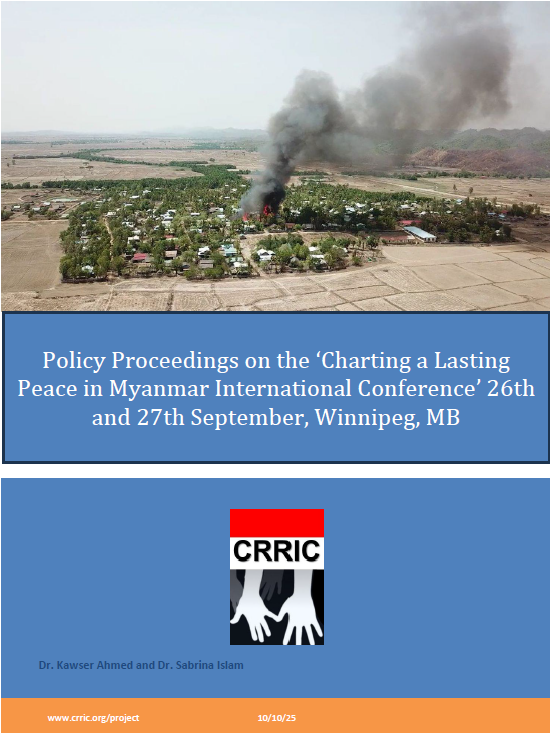
Rakhine captures nearly every major national dynamic — ethnic division, displacement, governance challenges, and the urgent need for inclusive reconstruction. It would still engage all principal stakeholder categories, while reducing the complexity of actors in other regions. If Smartsettle succeeds here, it would validate our approach as a proof-of-concept for the rest of Myanmar.
Political realism and safety
A Rakhine-based initiative could advance quietly, framed as humanitarian and developmental, not political. It wouldn’t require immediate national recognition, addressing one of the main practical barriers to national engagement. The question of who governs the entire country can remain open for later stages.
Operational feasibility
Through CRRIC, Smartsettle, and our partner networks, we already have access to Rakhine diaspora, Rohingya representatives in Bangladesh, and strong academic and international connections. That gives us a realistic way to convene meaningful simulations and training without depending on unstable in-country logistics.
Strong benefit-to-cost rationale
Even scaled down, Rakhine’s annual conflict cost likely exceeds $2–7 billion, implying a potential peace dividend of $20–70 billion over ten years. A Rakhine “mini–Marshall Plan” might cost only $1–2 billion to implement — preserving the same high benefit-to-cost ratio as our national estimates but with a clearer, more fundable scale.