
Overview
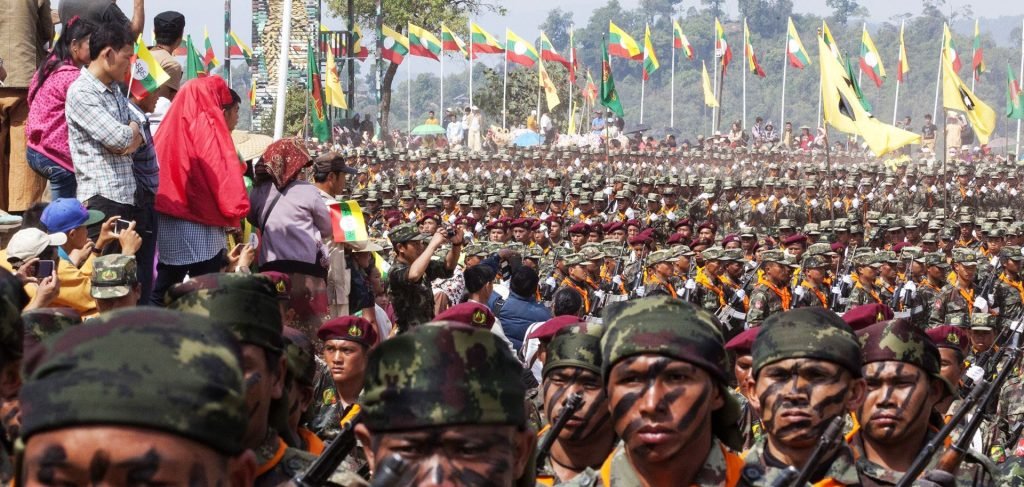
Myanmar (also known as Burma) remains mired in a protracted civil war that escalated following the military coup on February 1, 2021. As of late November 2025, the country is entering its fifth year of intensified conflict, with the military junta—led by Senior General Min Aung Hlaing—facing significant territorial losses to a coalition of ethnic armed organizations (EAOs), People’s Defense Forces (PDFs), and the shadow National Unity Government (NUG). The junta controls approximately 21% of the territory, while resistance forces hold about 42%, with the remainder contested. This fragmentation has triggered one of the world’s largest humanitarian crises, displacing nearly 3.6 million people internally and exacerbating food insecurity, health emergencies, and human rights abuses. The situation is dynamic, with ongoing clashes, airstrikes, and displacement reported daily.
Political and Military Situation
- Junta’s Grip Weakens Amid Resistance Gains: Resistance forces, including the Arakan Army (AA) in Rakhine State, the Kachin Independence Army (KIA), and PDFs in central regions like Sagaing and Mandalay, have captured key towns and border crossings. Recent advances include the seizure of Mawdaung and its vital Thai border post by the Karen National Liberation Army (KNLA) and PDFs in mid-November, capturing 43 junta soldiers. In Chin State, the Chin Brotherhood Alliance ambushed a 400-strong junta column near the Indian border in mid-November, killing over 40 troops and taking prisoners. However, October saw setbacks for rebels, such as the Ta’ang National Liberation Army (TNLA) agreeing to a China-brokered ceasefire after losing towns like Kyaukme and Hsipaw, abandoning positions in Mogok and Momeik to local PDFs.
- Sham Elections Loom: The junta ended its extended “state of emergency” on July 31, 2025, paving the way for “elections” planned for December 2025–January 2026, which it claims will be “free and fair.” Only six pro-junta parties qualify, and the vote will likely occur only in junta-held areas, with by-elections elsewhere. Critics, including the EU and human rights groups, denounce it as illegitimate, predicting violence to suppress opposition. An October 2025 census with 68 questions appears designed to identify activists and recruits. Martial law was imposed on 63 townships in August, targeting resistance strongholds.
- External Influences: China has emerged as the junta’s primary backer, providing arms and funding to protect Belt and Road projects and rare earth mineral access, while pressuring rebels (e.g., mediating ceasefires with the TNLA and Myanmar National Democratic Alliance Army). ASEAN’s mediation efforts, led by Malaysia, have stalled, with calls for dialogue ignored. The U.S. maintains a Level 4 “Do Not Travel” advisory due to armed conflict and risks.
Key Factions and Control (as of November 2025) |
Junta (State Administration Council): 21% territory; focuses on airstrikes and scorched-earth tactics. |
EAOs & PDFs (e.g., AA, KIA, KNLA): 42% territory; advancing in border regions and heartland, but facing coordination challenges. |
NUG: Shadow government with 93% public support; coordinates resistance but lacks unified command. |
Contested Areas: 37%; sites of frequent clashes, e.g., Inle Lake region where junta forces burned villages in November. |
Humanitarian Crisis
- Displacement and Needs: Nearly 20 million people (35% of the population) require aid, including 6.4 million children. Internal displacement hit 3.6 million by mid-November due to renewed fighting in October–November. In Chin State alone, over 20,000 (including 3,000 children) fled junta offensives in Falam. Rohingya in Rakhine face dual threats from the junta and AA, with 380,000 displaced since late 2023 and thousands fleeing to Bangladesh. Over 11,000 Rohingya attempted sea journeys since 2023, with 800+ deaths.
- Food and Health Emergencies: Myanmar is a “very high concern” hunger hotspot, with 16.7 million facing acute food insecurity and 58% of Rakhine families unable to meet basic needs. A March 2025 earthquake (magnitude 7.7) killed thousands and compounded the crisis, but post-quake ceasefires collapsed amid junta airstrikes. Health attacks surged: 169 on facilities in early 2025. Vaccination campaigns risk reversal due to conflict, threatening regional outbreaks. Nearly 5 million children are out of school, increasing risks of recruitment, child labor, and early marriage.
- Refugee Flows: Over 1 million Rohingya refugees remain in Bangladesh camps, facing floods and limited solutions. UNHCR calls for expanded resettlement to the U.S., Canada, and Australia.
Human Rights and Atrocities
The junta’s tactics—classified as war crimes and crimes against humanity—include indiscriminate airstrikes, landmines, and village burnings. In June–September 2025, strikes in Karenni and Karenni-Shan killed 55 civilians (including children) and injured 40+, targeting schools, churches, and camps. An October 6 airstrike on a Buddhist festival in Sagaing killed 24, including resistance fighters. Landmines caused 889 civilian casualties (245 children) in early 2024, with numbers likely higher. Over 22,000 political prisoners are detained, and impunity persists. The Anti-Fascist International Front, a new rebel group, fights in areas like Falam.
International Response
- U.S. Policy Shift: On November 24, 2025, the Trump administration terminated Temporary Protected Status (TPS) for ~4,000 Myanmar nationals, effective November 25, citing “improved security” and elections—despite the ongoing war. Rights groups condemned it as “insane and cruel,” warning of deportation to peril. This reverses Biden-era extensions.
- Global Calls: The UN, UNICEF, and OCHA urge ceasefires, aid access, and accountability via the Independent Investigative Mechanism for Myanmar. France marked the November 8 anniversary of the 2020 elections (overturned by the coup) by condemning violence. The U.S. Institute of Peace warns of urban escalation in 2025, urging adaptation to resistance gains.
The crisis risks regional spillover, with calls for ASEAN and China to prioritize peace over interests. For real-time updates, monitor sources like the UN OCHA or Democratic Voice of Burma.
UN AND ASEAN Effectiveness in the Myanmar Conflict
Overview of the Myanmar Conflict
The conflict in Myanmar, intensified by the military coup on February 1, 2021, has evolved into a full-scale civil war involving the junta (State Administration Council), the shadow National Unity Government (NUG), People’s Defence Forces (PDFs), and ethnic armed organizations (EAOs). As of November 2025, the violence has displaced over 3 million people, caused more than 75,000 deaths, and exacerbated a humanitarian crisis, including the aftermath of a March 2025 earthquake. The junta controls only about 14% of territory and 33% of the population, but continues brutal tactics like airstrikes and scorched-earth policies. Both the United Nations (UN) and the Association of Southeast Asian Nations (ASEAN) have engaged extensively, but their efforts have yielded limited results in de-escalating the conflict or fostering lasting peace.
The UN’s Role and Effectiveness
The UN has focused on condemnation, accountability mechanisms, and humanitarian aid, but its impact has been hampered by geopolitical divisions, particularly in the Security Council (UNSC), and operational constraints. While it has documented atrocities and provided some relief, critics argue the organization has prioritized bureaucratic presence over bold action, allowing the crisis to deepen.
Key Actions and Achievements
- Resolutions and Condemnation: The UNSC passed its first-ever resolution on Myanmar (2669) in December 2022, condemning junta abuses and calling for an end to violence. A second resolution was permitted by China in December 2023, urging dialogue and aid access. In June 2025, the UN High Commissioner for Human Rights warned of a “spiralling humanitarian catastrophe” amid collapsing aid systems.
- Accountability Mechanisms: The Independent Investigative Mechanism for Myanmar (IIMM), established in 2018, continues collecting evidence of international crimes, supporting potential ICC prosecutions. The UN has also backed the International Court of Justice (ICJ) genocide case against Myanmar over the Rohingya crisis.
- Humanitarian Response: The 2025 Myanmar Crisis Response Plan targets 19.9 million people with $107 million in multi-sectoral aid, including via UNHCR for displaced populations. The UNODC’s 2021-2025 strategy addresses drug production and transnational crime linked to the conflict.
Limitations and Criticisms
- Political Inaction: Despite resolutions, the junta has ignored them, and the UNSC has not imposed arms embargoes or referrals to the ICC for post-coup crimes. Only one resolution has passed since Myanmar’s 1948 UN admission, reflecting veto threats from China and Russia. Special envoys, including Julie Bishop (appointed 2024), have made limited progress due to junta non-engagement.
- Aid Delivery Failures: Aid is largely routed through junta-controlled Yangon, excluding resistance-held areas where most needs exist. This has left millions unreached, eroding trust; the UN’s fear of expulsion has led to “prioritizing presence over effectiveness.”
- Broader Failures: No invocation of the Responsibility to Protect (R2P) doctrine despite civilian targeting, and delayed accountability (e.g., ICC warrants). As of November 2025, UN investigations document daily atrocities, but the conflict persists unabated.
Recent Developments (as of November 2025)
Singapore’s UN statement highlighted the “dire” situation, with heavy casualties and earthquake recovery stalled by fighting, urging a Myanmar-led solution via ASEAN and UN envoys. The UN Secretary-General called on ASEAN in October 2025 to prioritize peace amid soaring needs and Rohingya displacement. Overall, the UN’s efforts are rated as a “failure” by experts, with marginal improvements but no end to violence.
Aspect | UN Achievements | Key Shortcomings |
Political | 2 UNSC resolutions (2022, 2023); envoy engagements | No sanctions/embargoes; junta ignores calls |
Humanitarian | $107M 2025 plan; evidence collection via IIMM | Aid restricted to junta areas; 3M+ displaced unreached |
Accountability | ICJ case support; potential ICC warrants | Delays in special tribunal; no R2P action |
ASEAN’s Role and Effectiveness
ASEAN, led by its “non-interference” principle, adopted the Five-Point Consensus (5PC) in April 2021 as its cornerstone response, emphasizing dialogue, ceasefire, and aid. However, internal divisions, junta intransigence, and reliance on annual chair rotations have stalled progress, weakening ASEAN’s regional centrality and credibility.
Key Actions and Achievements
- Diplomatic Framework: The 5PC calls for an immediate end to violence, envoy mediation, inclusive dialogue, humanitarian access, and election assistance. A Comprehensive Assessment (2021-2025) was completed, and a Special Envoy (rotating annually) has facilitated some trust-building.
- Humanitarian Efforts: The ASEAN Humanitarian Assistance Centre (AHA Centre) delivered aid in Phases 1 and 2, including post-earthquake support. Joint visits (e.g., Malaysia-Thailand in April 2025) and the Malaysian Foreign Minister’s October 2025 trip to Naypyitaw advanced limited access.
- Engagement with Stakeholders: Under Malaysia’s 2025 chairmanship, ASEAN held broader consultations in Kuala Lumpur, engaging the NUG and EAOs. It has pushed ceasefires (e.g., via May 2025 statement) and addressed border issues like scam centers.
Limitations and Criticisms
- Implementation Gaps: The 5PC has seen “no substantive progress,” with the junta barring full envoy access and rejecting dialogue. Divisions among members—e.g., Cambodia/Philippines questioning its relevance vs. Singapore/Malaysia’s opposition to sham elections—have caused policy paralysis.
- Divisions and External Influence: Rifts surfaced in 2024-2025 meetings, with Vietnam proposing stakeholder inclusion and Thailand acting as a junta conduit. China’s pressure (e.g., on scam centers) has driven action, undermining ASEAN’s independence. The bloc’s exclusion of the junta from summits has isolated it but not coerced compliance.
- Election Stance: ASEAN noted junta election preparations for December 2025 but stressed violence must cease first; however, it lacks unified rejection of the “sham” polls, risking legitimacy.
Recent Developments (as of November 2025)
At the October 2025 ASEAN Summit, leaders reaffirmed the 5PC, denounced civilian attacks, and urged de-escalation ahead of elections, while maintaining non-political junta representation. Foreign ministers voiced “concern” in October, calling for aid and dialogue. Yet, as February 2025 analyses noted, the crisis exposes ASEAN’s weakening centrality amid great-power competition.
Aspect | ASEAN Achievements | Key Shortcomings |
Diplomatic | 5PC framework; multi-stakeholder consultations under Malaysia 2025 | Divisions block enforcement; envoy access limited |
Humanitarian | AHA Centre aid phases; joint visits | Scaled-up needs unmet; border crises persist |
Political | Ceasefire pushes; election preconditions | No unified election rejection; China-driven actions |
Overall Assessment
Both the UN and ASEAN have been largely ineffective in managing the conflict, failing to halt violence or achieve political resolution after nearly five years. The UN’s global mandate is undercut by veto powers and aid bottlenecks, while ASEAN’s regional proximity is neutralized by consensus-based divisions and non-interference norms. Humanitarian gains exist but are insufficient against escalating needs, and the junta’s planned 2025 elections—widely seen as fraudulent—threaten further instability. Experts recommend UN-ASEAN coordination, including arms embargoes, NUG engagement, and special tribunals, for any chance of progress. A Myanmar-led solution remains elusive without stronger international pressure.
Canada. UK. EU and Australia’s Role in the Conflict
Overview of the Myanmar Conflict
The Myanmar conflict, triggered by the February 1, 2021, military coup, has escalated into a multifaceted civil war involving the junta (State Administration Council), the National Unity Government (NUG), People’s Defence Forces (PDFs), and ethnic armed organizations (EAOs). As of November 2025, it has displaced over 3.5 million people, caused tens of thousands of deaths, and worsened humanitarian needs amid ongoing violence and natural disasters like the March 2025 earthquake. Canada, the European Union (EU), the United Kingdom (UK), and Australia—key Western actors with historical ties to Myanmar—have responded through coordinated sanctions, diplomatic condemnations, humanitarian aid, and advocacy for accountability. Their efforts emphasize isolating the junta economically and politically while supporting civilians and resistance groups, often in joint statements. However, challenges include junta defiance, limited aid access, and geopolitical constraints, resulting in partial effectiveness.
Canada’s Role
Canada has taken a proactive stance, leveraging its early recognition of the Rohingya genocide (2018) to expand sanctions and diplomatic pressure post-coup. As a G7 member, it coordinates with allies and funds peace-building initiatives, focusing on human rights and humanitarian relief.
Key Actions and Achievements
- Sanctions: Imposed targeted sanctions on over 20 junta officials and entities since 2021, including a March 2025 expansion with an arms embargo, aviation fuel import ban, and dealings prohibition on listed persons. This aims to curb the junta’s revenue from natural resources.
- Diplomatic Efforts: Co-led joint statements, such as the January 2025 declaration on the coup’s fourth anniversary, condemning violence and urging dialogue. Canada supports UN mechanisms like the Independent Investigative Mechanism for Myanmar (IIMM).
- Humanitarian and Development Aid: Allocated millions for Rohingya and conflict-affected populations, including post-earthquake relief. Funded a April 2025 research project at the University of Winnipeg to build peace through community reconciliation.
Limitations
Canada’s measures have isolated the junta but not halted atrocities, with aid often blocked in resistance areas. Critics note slower implementation compared to initial promises.
Aspect | Key Actions | Impact/Updates (2024-2025) |
Sanctions | Arms embargo, fuel bans (Mar 2025) | Targeted 20+ entities; revenue disruption |
Diplomatic | Joint statements; UN support | Pushed for elections preconditioned on ceasefire |
Aid | $10M+ for humanitarian needs | Funded peace research; Rohingya focus |
The EU’s Role
The EU, as Myanmar’s largest pre-coup donor, shifted from development aid to targeted pressure post-2021, emphasizing multilateralism through UN and ASEAN channels. It has condemned the junta’s “sham” elections and advocated for resistance support.
Key Actions and Achievements
- Sanctions: Expanded the EU’s regime targeting 25 individuals and 15 entities by 2025, including asset freezes and travel bans on military-linked businesses. Aligned with G7 for aviation fuel restrictions.
- Diplomatic Efforts: Issued strong condemnations, including October 2025 criticism of planned December elections as lacking credibility. Supported ICJ Rohingya case and called for atrocity accountability in January 2025 joint statement with 46 organizations.
- Humanitarian Aid: Allocated €46 million in 2025 for vulnerable groups, focusing on food, health, and displacement via ECHO. Scaled back pre-coup investments but increased cross-border aid.
Limitations
Internal coordination delays and non-interference norms in ASEAN limit enforcement. The EU’s pre-coup liberalization investments created hesitancy, with calls for more direct resistance support.
Aspect | Key Actions | Impact/Updates (2024-2025) |
Sanctions | 25 individuals, 15 entities targeted | Business freezes; aligned with G7 |
Diplomatic | Election condemnations (Oct 2025) | UN/ICJ advocacy; resistance state-building push |
Aid | €46M humanitarian funding | Immediate needs; cross-border delivery |
The UK’s Role
The UK, with colonial history in Myanmar, has prioritized sanctions and human rights advocacy via the UN Security Council (as a permanent member). Post-Brexit, it aligns closely with the EU and US but faces criticism for aid reductions.
Key Actions and Achievements
- Sanctions: Designated 39 individuals and 37 entities by April 2025, including military figures and conglomerates for coup involvement and abuses. Enforced asset freezes and export bans on dual-use goods.
- Diplomatic Efforts: Co-signed the January 2025 joint statement urging violence cessation and prisoner releases. Pushed UNSC resolutions and warned of business risks in October 2025 advisory.
- Humanitarian Aid: Provided £20 million+ since 2021, though cut by 70% from pre-coup levels due to junta restrictions. Supported Rohingya resettlement and earthquake response.
Limitations
Aid cuts have drawn backlash, and sanctions enforcement is hampered by overseas territories facilitating junta finance. Calls in October 2025 urged resuming regular designations.
Aspect | Key Actions | Impact/Updates (2024-2025) |
Sanctions | 39 individuals, 37 entities (Apr 2025) | Human rights targeting; export controls |
Diplomatic | UNSC pushes; joint statements | Business risk advisories (Oct 2025) |
Aid | £20M+ but 70% cut | Rohingya/earthquake focus; access issues |
Australia’s Role
Australia, as a regional Indo-Pacific power, balances ASEAN ties with firm anti-junta measures, emphasizing targeted sanctions and humanitarian support. It engages bilaterally and through Quad alliances.
Key Actions and Achievements
- Sanctions: Imposed on 16 individuals and 2 military conglomerates in February 2023, expanded to include aviation and gem trade bans. Coordinates with US for enforcement.
- Diplomatic Efforts: Issued June 2025 UN statement on civilian attacks and sexual violence. Joined January 2025 joint declaration and advocates Myanmar-led solutions via ASEAN.
- Humanitarian Aid: Contributed $9 million for earthquake relief (May 2025) and ongoing support for 3.5 million displaced, including Rohingya. Works with civil society like Justice For Myanmar.
Limitations
Inaction pre-2023 drew criticism, and proximity to ASEAN limits bolder steps. Regional stability concerns temper support for armed resistance.
Aspect | Key Actions | Impact/Updates (2024-2025) |
Sanctions | 16 individuals, 2 conglomerates (2023+) | Aviation/gem bans; Quad alignment |
Diplomatic | UN condemnations (Jun 2025) | ASEAN engagement; joint statements |
Aid | $9M earthquake aid | Displacement support; civil society partnerships |
Overall Assessment
Canada, the EU, the UK, and Australia have played complementary roles, with over 120 combined sanctions designations isolating the junta financially and diplomatically. Joint actions, like the January 2025 statement, amplify pressure, while €100M+ in collective aid addresses immediate crises. However, effectiveness is curtailed by junta resilience, aid blockages, and vetoes in global forums. As the December 2025 elections loom, these actors urge unified rejection and enhanced resistance support. Greater coordination with the US and UN could bolster outcomes, but a resolution hinges on Myanmar’s internal dynamics.
Rakhine Situation
Current Situation in Rakhine State, Myanmar
As of November 25, 2025, Rakhine State (also known as Rakhine in some transliterations) remains one of the most volatile and humanitarianly challenged regions in Myanmar. The area is gripped by intense armed conflict between the Myanmar military junta (Tatmadaw) and the Arakan Army (AA), an ethnic Rakhine insurgent group, alongside clashes involving Rohingya armed factions. This has compounded longstanding issues like the 2017 genocide against the Rohingya Muslim minority, leading to widespread displacement, acute food insecurity, and restricted humanitarian access. The junta’s blockade on aid since 2023, combined with AA-imposed movement restrictions, has created a “deadly combination” of famine and atrocity crimes, as described by rights groups.
Northern Rakhine townships like Maungdaw, Buthidaung, and Rathedaung are hardest hit, with reports of airstrikes, shelling, landmines, and village burnings forcing mass flight. Recent escalations include junta raids since mid-November that displaced around 35,000 people from 42 villages into forests and hills, and AA drone attacks killing civilians. Intercommunal tensions persist, with Rohingya facing abuses from both sides, including forced recruitment, arbitrary detentions, and denial of return to homes.
Humanitarian Conditions and Challenges
The polycrisis—conflict, economic collapse, and natural disasters like the March 2025 earthquake and monsoon floods—has pushed Rakhine to the brink. Key issues include:
- Food Insecurity and Malnutrition: Rakhine is a UN-designated “hunger hotspot of very high concern.” Nearly 15 million people nationwide face acute hunger in 2025, but Buthidaung Township risks Phase 5 (Catastrophe/Famine) within months, with child malnutrition rates surging due to destroyed crops, empty markets, and aid blockades. Displaced families often boil grass for sustenance, and women bear disproportionate care burdens.
- Health and Disease Outbreaks: Over 3,700 skin infections reported since early 2025 due to poor sanitation; malaria cases exceed 1,000 with 30+ deaths. Cholera threatens amid limited clean water. A November 17 landmine blast in Maungdaw severed a Rohingya man’s leg, highlighting unexploded ordnance risks.
- Access Restrictions: The junta bans most aid convoys, while AA limits Rohingya movement, farming, and fishing. This violates international law and ICJ provisional measures ordering Rohingya protection. Only 12% of the 2025 Myanmar Humanitarian Needs Plan ($1.1 billion requested) is funded, leaving 19.9 million in need underserved.
Key Humanitarian Indicators in Rakhine (as of Nov 2025) | Estimate | Source Notes |
Acute Food Insecurity (people) | 350,000+ | WFP; highest in conflict zones |
Malnutrition Cases (children under 5) | Rapidly deteriorating | OCHA; projected famine in Buthidaung |
Disease Outbreaks (skin infections/malaria) | 3,700+ / 1,000+ cases | OCHA/ACAPS |
Aid Funding Gap | 88% unfunded | UN 2025 Plan |
Status of Displaced People
Myanmar has nearly 3.6 million internally displaced persons (IDPs) nationwide, with Rakhine hosting over 560,000—up from 380,000 since late 2023 due to renewed fighting. This includes ~210,000 Rohingya confined to 2012-era camps south of Sittwe, facing severe movement curbs, and ~350,000 newly displaced from AA-junta clashes. Many live in overcrowded tarpaulin shelters, monasteries, or forests, lacking food, medicine, and protection. Women and children (61% of IDPs) are most vulnerable to gender-based violence and exploitation.
Cross-border flight continues: Over 150,000 Rohingya have entered Bangladesh since late 2023, swelling Cox’s Bazar camps to 1.2 million refugees amid floods damaging 1,400+ shelters. Sea journeys to Malaysia are deadly—800+ Rohingya missing or dead since 2023—with a recent boat sinking highlighting pushbacks. Repatriation efforts stall; Bangladesh seeks a “humanitarian corridor,” but conditions in Rakhine make returns “catastrophic,” per Amnesty International. Some families have trickled back, but rights groups warn of ongoing genocide risks.
Displacement Breakdown in Rakhine (Nov 2025) | Number Affected | Primary Causes |
Total IDPs | 560,000 | Conflict since 2023; includes pre-2017 Rohingya camp residents |
New Displacements (Oct-Nov 2025) | 35,000+ | Junta raids, AA airstrikes |
Rohingya in Camps (pre-2017) | 210,000 | Movement restrictions, aid denial |
Refugees to Bangladesh (since 2017) | 1.2 million | Genocide, recent violence |
International Response and Calls to Action
The UN, UNHCR, and groups like Amnesty and Human Rights Watch urge enforcement of ICJ orders and UNSC Resolution 2669 for aid access and accountability. The 2025 response plans aim to assist 4.2 million displaced/stateless, but funding shortfalls persist. Rohingya advocates demand global pressure on Myanmar and AA to end blockades, allow returns, and prosecute abuses. Bangladesh, hosting the world’s largest refugee camp, calls repatriation the “only peaceful option” but stresses Myanmar’s responsibility.
The crisis risks further spillover, including regional infiltration concerns in India and potential Bangladesh military involvement in Rakhine. Without urgent intervention—diplomatic leverage, funding, and investigations—famine and deaths could surge, erasing communities through “starvation and forced labor,” as one report warns.